

Employment Data Weakens
Economic data releases continued to be at the forefront for investors this week as monthly employment figures were announced, along with additional inflation data and activity surveys.
Among the employment data was a lower-than-expected increase in nonfarm payrolls. The reported level of 73,000 was significantly lower than the expectation of an increase of 115,000. Not only was the current month below the consensus forecast, but the reported levels for the prior two months were revised lower by 258,000. For the month of June specifically, the originally reported increase of 147,000 jobs was revised down to 14,000, the lowest in almost five years.
The Institute of Supply Management (ISM) surveys for the month of July were also announced last week with both the manufacturing and services surveys coming in lower-than-expected and lower than the prior month.
With the weaker than forecasted employment data announced last week the probability of a cut in the Fed Funds rate now hovers around 90% for the Federal Reserve’s meeting in September. Along with this potential rate reduction there is currently a strong probability of a second cut prior to the end of the year.
Potential Rate Cut Obstacle
While the probability of rate cuts moved higher, one potential impediment to an easing of monetary policy was also included in this week’s slate of economic data releases. Core PCE, the Fed’s preferred gauge of inflation, came in slightly higher-than-expected for the month of June with a year-over-year rate of 2.8%. The month-over-month result of 0.3% was in line with forecasted levels. Going forward all inflation measures will be monitored closely as many economists anticipate potential increases in these indices during the second half of 2025 as tariff-induced price increases funnel through the economy.
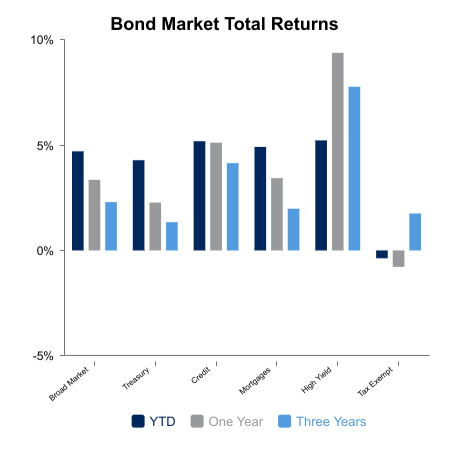
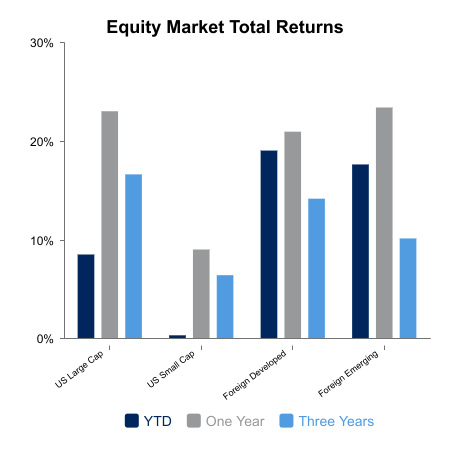
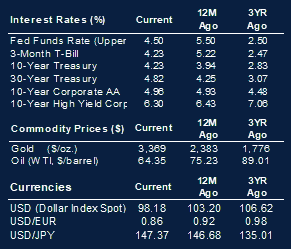
The yield on the 10-year Treasury note fell in response to the tepid economic releases falling from 4.37% to 4.23%. This helped push the bond market higher with a return of 1.0% for the week. Stocks, on the other hand, experienced negative returns with the Russell 1000 Index returning -0.4% and the Russell 2000 Index of small companies registering a return of -0.9%.
Earnings reports for the second quarter continue to be reported and as of August 1, 66% of U.S. companies in the Standard & Poor’s 500 Index had reported their results. Of those reporting, 82% had reported positive earnings surprises and 79% had positive revenue surprises. Taking into account the companies that have reported and the expected results for those that are yet to report yields an overall growth rate of 10.3% according to FactSet. Currently, earnings for the Standard & Poor’s 500 Index companies are expected to grow 7.6% in the third quarter.
 |
 |
Sources: BTC Capital Management, FactSet Research Systems Inc., Federal Open Market Committee (Federal Reserve) LSEG I/B/E/S, FTSE Russell (an LSEG Group company), S&P Global, U.S. Bureau of Labor Statistics, U.S. Census Bureau
The information provided has been obtained from sources deemed reliable, but BTC Capital Management and its affiliates cannot guarantee accuracy. Past performance is not a guarantee of future returns. Performance over periods exceeding 12 months has been annualized.
This content is provided for informational purposes only and is not intended as an offer or solicitation with respect to the purchase or sale of any security. Statements in this report are based on the views of BTC Capital Management and on information available at the time this report was prepared. Rates are subject to change based on market and/or other conditions without notice. This commentary contains no investment recommendations and should not be interpreted as investment, tax, legal, and/or financial planning advice. All investments involve risk, including the possible loss of principal. Investments are not FDIC insured and may lose value.