

Key Takeaways
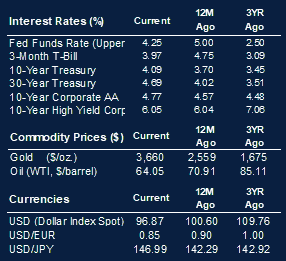
- The Federal Reserve cut the benchmark interest rate by 0.25% to 4.25%, noting further cuts in 2025.
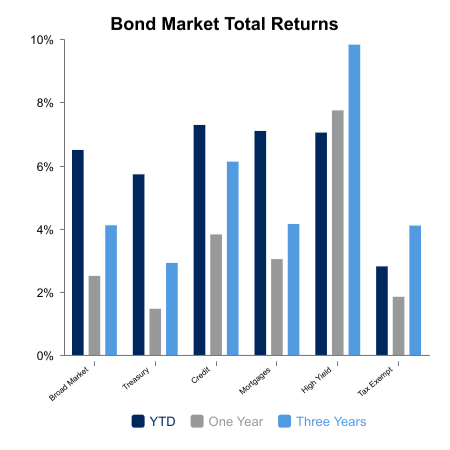
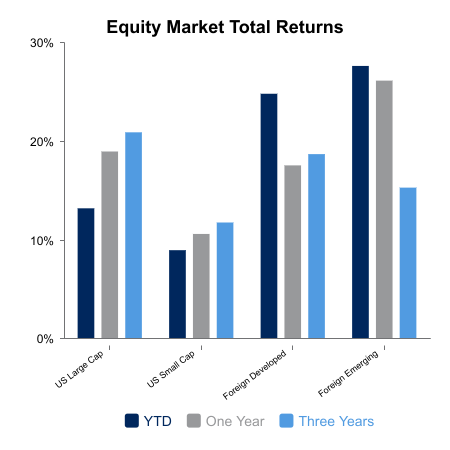
- Both bond and equity markets paused this week after 2.4% and 6.7% returns Q3 to date.
- While sentiment measures weaken, consumer spending reflects resiliency.
Federal Reserve Chair, Jerome Powell, was able to rally a deeply divided policy-making committee to an interest rate cut, the first of the year, for a quarter-point reduction to 4.25%. The Chair noted a significant slowdown in job growth leading policymakers to cut rates as insurance against slow rising unemployment. Also released were the committee members’ median projections that revealed members favored two more reductions of overnight borrowing rates to 3.75% by year end, one cut in 2026, one cut in 2027, to bring the target to around 3.0% in 2028.
Returns from the bond market were unchanged while equity markets measured by the Russell 1000 gained only 0.2% this week. This week markets appear to have paused in what has turned out to be strong quarter as bond returns advanced 2.4% and equity markets 6.7%.
This week U.S. consumer sentiment fell in September to the lowest since May to 55.4 from 58.2 in August, according to the University of Michigan survey. Seven in 10 consumers surveyed expect prices to rise faster than income over the next 12 months. This follows reports of a materially slowing labor market with just 22,000 jobs added in August. Also, consumer prices rose at the fastest monthly pace since the beginning of the year.
Despite dampened sentiment, U.S. retail sales rose for a third month by 0.6% in August as back-to-school buying led nine of 13 sales categories higher. Though wage growth has cooled, and tariffs boost the cost of goods, workers’ pay gains continue to outpace inflation. Sales growth is likely to downshift in coming months as average hourly earnings in August continued to slow to a 3.7% annual rate from 3.9% posting a 0.7% real wage growth over inflation year-over-year.
August’s headline Consumer Price Index (CPI) rose 2.9% (versus 2.7% prior), while core inflation, a measure that excluded volatile components like food and energy to provide a more stable view of inflation, remained at 3.1%. Higher cost of used cars, hotels and airfare that normally rise in a solid economy were a primary source of August’s rising core CPI print.
 |
 |
Sources: BTC Capital Management, FactSet Research Systems Inc., Federal Open Market Committee (Federal Reserve) LSEG I/B/E/S, FTSE Russell (an LSEG Group company), S&P Global, U.S. Bureau of Labor Statistics, U.S. Census Bureau
The information provided has been obtained from sources deemed reliable, but BTC Capital Management and its affiliates cannot guarantee accuracy. Past performance is not a guarantee of future returns. Performance over periods exceeding 12 months has been annualized.
This content is provided for informational purposes only and is not intended as an offer or solicitation with respect to the purchase or sale of any security. Statements in this report are based on the views of BTC Capital Management and on information available at the time this report was prepared. Rates are subject to change based on market and/or other conditions without notice. This commentary contains no investment recommendations and should not be interpreted as investment, tax, legal, and/or financial planning advice. All investments involve risk, including the possible loss of principal. Investments are not FDIC insured and may lose value.