

Policy Rhetoric Spurs Further Broadening in Equity Performance
Key Takeaways
- The S&P 500 Equal-Weight Index is outperforming year-to-date.
- Software industry comes under pressure.
- Economic data remains steady.
The S&P 500 finished the week fractionally in the green. The broadening out of market performance continued as the S&P 500 Equal-Weight Index was up 2.0%. The NASDAQ 100 was down 0.7% with software names exhibiting significant underperformance. The S&P 500 Equal-Weight Index is up 3.7% year-to-date versus a decline of 1.5% in the Magnificent 7 Index.
Another way to look at the broadening of market performance is the ratio of stocks hitting 52-week highs. The NYSE Composite Index was up 17.4% in 2025. Over the first 11 months of 2025 the highest ratio of stocks hitting a 52-week high on a single day was 3.57%. But over the last six weeks, the ratio of new 52-week highs has surpassed 3.57% on three separate occasions.
The S&P 500 Software Index was down 5% on the week. Over the last 90 days, they have underperformed by nearly 14%. This level of weakness has only occurred twice in the last 20 years. In 2006, Microsoft fell sharply following weak earnings guidance and dragged the space lower over the ensuing weeks. Another similar drawdown occurred in 2022, when inflation and rising interest rates caused the sector P/E ratio to contract from 49 to 27.
Software names have failed to meet expectations on AI-related revenue growth to this point. This has cast doubt on whether their high valuation is justified. Higher AI-related productivity is leading to employment reductions and lower total spending on traditional software licenses. There is a theory that AI will commoditize code and create a deflationary wave for software. Visibility is cloudy at this point, whereas hardware has a clear revenue outlook. The result is that over the last three years, semiconductor names have gained four times more than returns generated by the software industry.
No surprises in the economic data
Economic data on the week was generally in line with consensus expectation. Nonfarm payrolls were up 50,000 in December. Private payrolls were lighter than expected, but jobless claims remain low. Housing data remains generally weak, but housing related equities bounced following news that President Trump would push to ban large institutional investors from buying more single-family homes. There was also a push for Fannie Mae and Freddie Mac to purchase a significant amount of mortgage bonds to lower mortgage rates.
The Citi Surprise Index has spent the last 12-months between -30 and 30, a level of consistency that has never been observed in the 22-year history of the series. This was probably not on the radar amid the peak tariff uncertainties in early April.
 |
 |
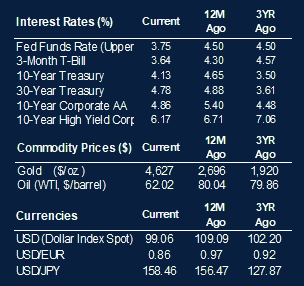
Sources: BTC Capital Management, Bloomberg
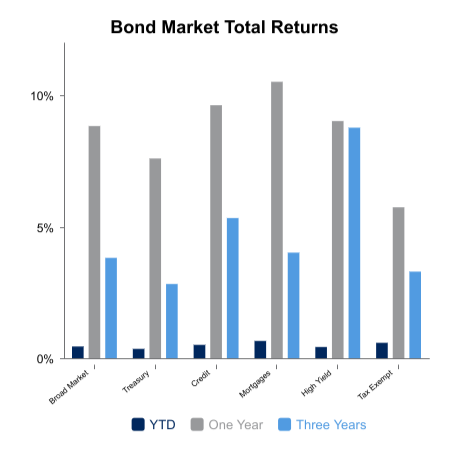
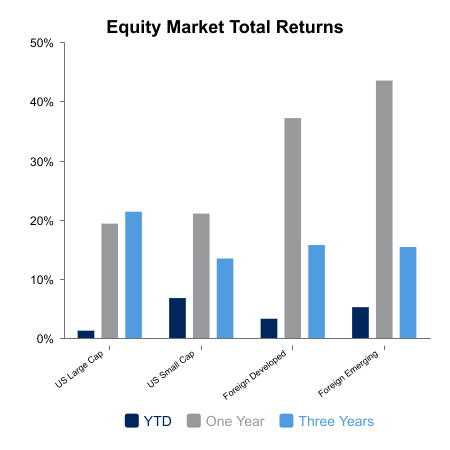
The information provided has been obtained from sources deemed reliable, but BTC Capital Management and its affiliates cannot guarantee accuracy. Past performance is not a guarantee of future returns. Performance over periods exceeding 12 months has been annualized.
This content is provided for informational purposes only and is not intended as an offer or solicitation with respect to the purchase or sale of any security. Statements in this report are based on the views of BTC Capital Management and on information available at the time this report was prepared. Rates are subject to change based on market and/or other conditions without notice. This commentary contains no investment recommendations and should not be interpreted as investment, tax, legal, and/or financial planning advice. All investments involve risk, including the possible loss of principal. Investments are not FDIC insured and may lose value.