

Inflation Pressures Continue Despite Signs of Economic Softening
Key Takeaways
- Inflation remains stubbornly above the Fed’s target.
- Economic growth signals are mixed.
- Investors shifted toward safety.
Updated inflation data was the dominant economic metric this week as the Consumer Price Index (CPI) for September was released. Gasoline prices were once again at the forefront of the larger than expected increase of 0.6% for the month with an increase of 9.1% month-over-month. Another strong contributor that is growing in importance as winter approaches was fuel oil which rose 15.3%. On a year-over-year basis, CPI increased 3.7% and excluding food and energy it rose 2.6%, both markedly higher than the 2.0% target that is consistently communicated by the Federal Reserve (Fed).
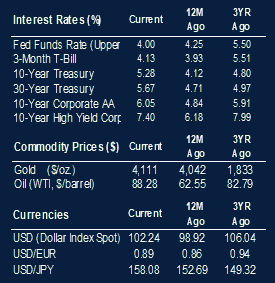
Despite the higher-than-expected results for inflation data, the probability of the Fed increasing the closely watched Fed Funds rate at their meeting later this month currently stands at 29%. Contributing to the low probability is the weak employment data released last week, and weak real average earnings data released this week that showed, on real terms, earnings have declined over the last year.
This data also did nothing to improve the mood of the American consumer as the preliminary reading of the University of Michigan Consumer Sentiment Index fell to 46.3 from its prior reading in September of 48.1. Concerns regarding the economy in general, and the cost of living more specifically, were key contributors to the weakness seen in the survey’s responses.
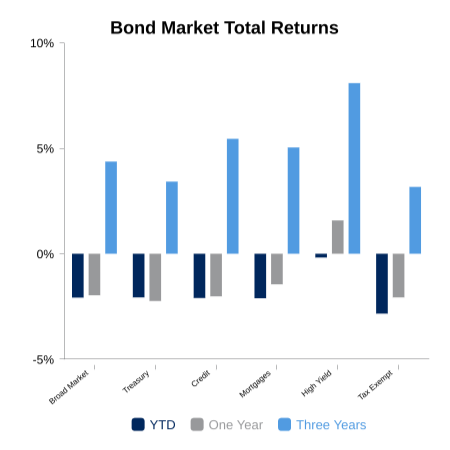
Combining these economic data points with growing concern regarding the ongoing AI buildout led to a positive return for bonds this week with the broad market higher by 0.6%. The positive move for the week helped to reduce the negative return of the year-to-date period down to -2.1%. Municipal bonds have also experienced a year-to-date decline with a return of -1.7%.
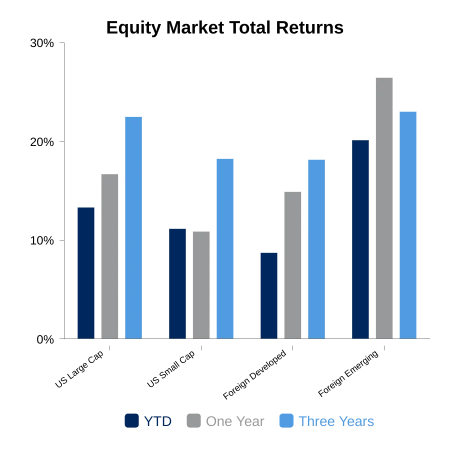
Equities moved in the opposite direction from bonds with the Russell 3000 Index of domestic stocks declining 1.5%. The decline was driven by weakness from the growth side of the equity spectrum as they were lower by 3.9%. Value stocks actually rose 0.9% as investors turned away from the technology sector, which returned -4.8%. International equities were mixed for the week as the developed outperformed U.S. equities while emerging markets, as measured by the MSCI Emerging Markets Index, were markedly weaker with a return of -3.8%. Despite the weekly lag, emerging market equities are the year-to-date leader with a return of 20.5%.
Also, third quarter earnings reports have begun, initially dominated by financial services companies. FactSet currently projects another strong quarter with year-over-year earnings growth of 29.6%.
 |
 |
Sources: BTC Capital Management, FactSet Research Systems Inc., Federal Open Market Committee (Federal Reserve) LSEG I/B/E/S, FTSE Russell (an LSEG Group company), S&P Global, U.S. Bureau of Labor Statistics, U.S. Census Bureau
The information provided has been obtained from sources deemed reliable, but BTC Capital Management and its affiliates cannot guarantee accuracy. Past performance is not a guarantee of future returns. Performance over periods exceeding 12 months has been annualized.
This content is provided for informational purposes only and is not intended as an offer or solicitation with respect to the purchase or sale of any security. Statements in this report are based on the views of BTC Capital Management and on information available at the time this report was prepared. Rates are subject to change based on market and/or other conditions without notice. This commentary contains no investment recommendations and should not be interpreted as investment, tax, legal, and/or financial planning advice. All investments involve risk, including the possible loss of principal. Investments are not FDIC insured and may lose value.