

Positive Markets to Start 2026
Key Takeaways
- Emerging market stocks lead the way in week one of 2026.
- Developments in Venezuela fail to impact financial markets.
- Economic releases illustrate stable to improving conditions.
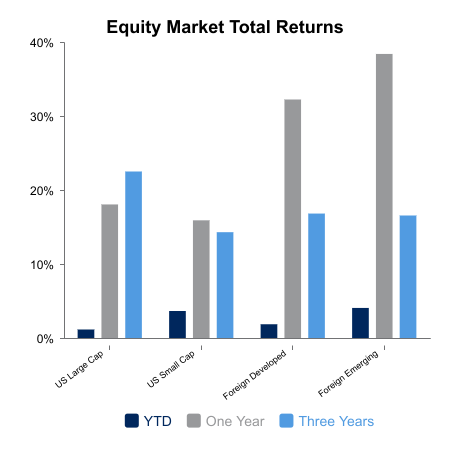
Financial markets started the new year on the plus side with major asset classes registering positive returns. Domestic equities, as measured by the Russell 3000 Index, returned 1.4% over the first four trading sessions of the year. Small cap stocks exhibited the strongest domestic performance out of the 2026 gate with a return of 3.8%. Emerging market equities have had an even stronger start, up 4.2%.
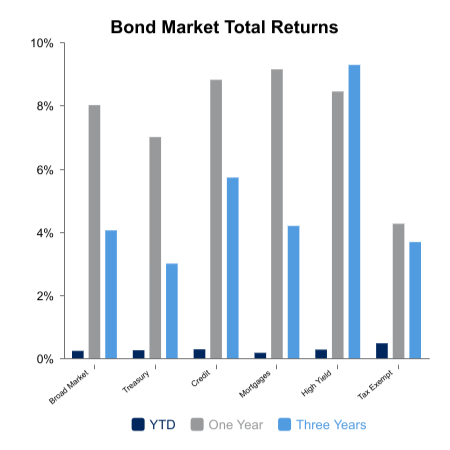
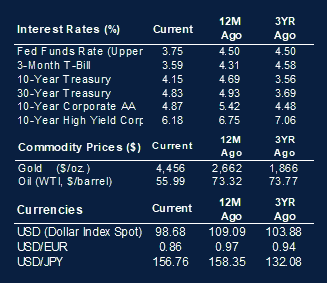
While fixed income returns lagged those of their equity counterpoints, the result was still positive at 0.3% for the broad bond market. The return is indicative of a stable rate environment as the 10-year U.S. Treasury yield was virtually unchanged at 4.17%. This level of return is in alignment with our expectations for fixed income this year in that most of the return generated by bonds will come from income and not price movement based on interest rate changes.
As evidenced by the financial market returns for the prior week, the developments occurring in Venezuela have had minimal impact to date. Even the price of West Texas Intermediate crude oil remains below $60 per barrel where it has resided over the past month.
On the economic front, it was acronym week as reports included updates on PMIs, including those from Standard & Poor’s and the Institute of Supply Management (ISM). In addition, the Job Openings and Labor Turnover Survey (JOLTS) report was released. The ISM Services PMI showed the largest deviation between the reported figures and the forecasted level anticipated by economists. This week’s release was for the month of December and came in at a level of 54.5, the highest level for the year. The measure’s prices paid component registered a nine-month low, a positive development on the inflation front.
The JOLTS report came in lighter than forecast and indicates that openings are at their lowest level since September 2024. While the report indicated fewer job openings it also indicated that the quit rate (a measure of individuals voluntarily leaving their jobs) ticked higher indicating some improvement in worker confidence as it pertains to finding a new position.
Next week we’ll see the beginning of earnings season for the fourth quarter. Currently, FactSet Research is projecting year-over-year growth of 8.3% for the Standard & Poor’s 500 Index. If this result comes to fruition, it will represent the 10th consecutive quarter the index has experience earnings growth. Numerous major financial institutions will be among the first to report their results, which are often seen to be a bellwether of the economy’s overall level of health.
 |
 |
Sources: BTC Capital Management, FactSet Research Systems Inc., Federal Open Market Committee (Federal Reserve) LSEG I/B/E/S, FTSE Russell (an LSEG Group company), S&P Global, U.S. Bureau of Labor Statistics, U.S. Census Bureau
The information provided has been obtained from sources deemed reliable, but BTC Capital Management and its affiliates cannot guarantee accuracy. Past performance is not a guarantee of future returns. Performance over periods exceeding 12 months has been annualized.
This content is provided for informational purposes only and is not intended as an offer or solicitation with respect to the purchase or sale of any security. Statements in this report are based on the views of BTC Capital Management and on information available at the time this report was prepared. Rates are subject to change based on market and/or other conditions without notice. This commentary contains no investment recommendations and should not be interpreted as investment, tax, legal, and/or financial planning advice. All investments involve risk, including the possible loss of principal. Investments are not FDIC insured and may lose value.