
Double Down Market – both stock and bond prices fall
Key Takeaways
- Chances of Fed hike rise, but it will be after Mid-terms.
- Job growth remains positive.
- Retails Sales kick up from World Cup boost.
This week saw both stock and bond markets move lower as the week was defined by an AI spending credibility debate in stocks and inflation-driven rates backup in bonds as oil prices climbed. In economic news, the week showed signs of rising inflation and slowing economic growth. Positive readings show labor markets remain tight, housing starts surprised to the upside, and consumer sentiment rebounded modestly. However, industrial production and manufacturing output were flat, the Conference Board Leading Indicators Index fell, and import price inflation accelerated on the back of higher oil prices.
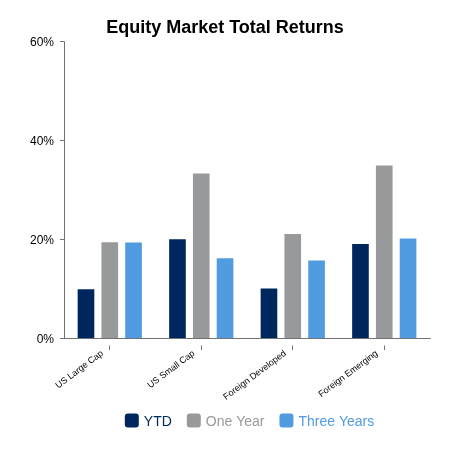
Lower stock prices (0.52%) this week reflect pullback in technology, consumer discretionary and financials that make up 63% of the Russell 3000 index, while advances were not enough in energy, consumer staples and utilities, more defensive sectors, which represent just 16% of this market index. Technology led the decline this week even as some firms reported better than expected earnings. Cash burn rates on new technology development and questions about the ability to monetize AI and robotics cost led to the sell off of this sector. Rising energy prices and investors looking for defensive sectors lifted the energy, consumer staples, and utilities sectors.
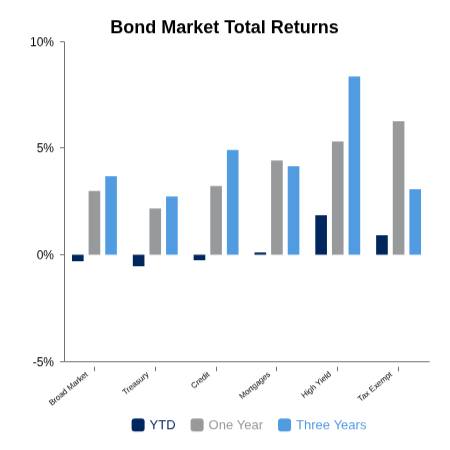
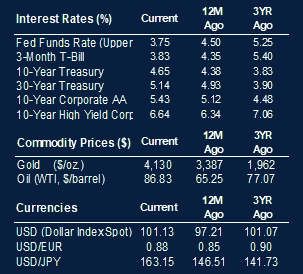
Treasurys sold off this past week with yields rising across every maturity of the yield curve. The U.S. Treasury 10-year yield climbed from 4.55% last Thursday to 4.65%, while the 30-year Treasury yield reached 5.14%, nearing its high for 2026. Reflecting the growing probability of a Fed rate hike, the 2-year yield rose from 4.14% to 4.30%. These rising rates are consistent with the now 68% probability of a Fed rate hike at the September meeting. However, lifting rates at the September and October meeting is not likely as November mid-term elections soon follow. This places the highest likelihood at the December 9 meeting of the Federal Open Market Committee.
Initial jobless claims, a count of new application for unemployment, came in at 187k, beating the 210k consensus and down 22k from the prior week’s revised 209k – the lowest reading in months. Continuing claims also fell to 1,790k, reinforcing a framework of a tightening labor market. Housing starts climbed to 1.43 million on an annualized basis above expectations, but building permits fell, suggesting the pipeline may be weakening. University of Michigan Consumer Sentiment measure rose to 54.4 from 49.5 and retail sales got a World Cup tournament kick, up 0.2% in June.
Industrial production rose just 0.1% while manufacturing output was flat along with capacity utilization holding at 76.1%. Inflation pressures continue to build as oil tops $90 and overall import price pressures rose 0.3% in the month of June, up 7.1% for the last 12 months.
 |
 |
Sources: BTC Capital Management, Bloomberg
The information provided has been obtained from sources deemed reliable, but BTC Capital Management and its affiliates cannot guarantee accuracy. Past performance is not a guarantee of future returns. Performance over periods exceeding 12 months has been annualized.
This content is provided for informational purposes only and is not intended as an offer or solicitation with respect to the purchase or sale of any security. Statements in this report are based on the views of BTC Capital Management and on information available at the time this report was prepared. Rates are subject to change based on market and/or other conditions without notice. This commentary contains no investment recommendations and should not be interpreted as investment, tax, legal, and/or financial planning advice. All investments involve risk, including the possible loss of principal. Investments are not FDIC insured and may lose value.