

Markets Continue to Search for Direction
Key Takeaways
- Bonds and stocks move lower.
- Productivity slows while labor costs rise.
- New home sales disappoint.
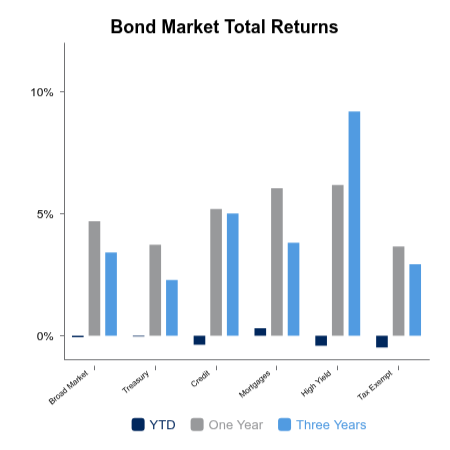
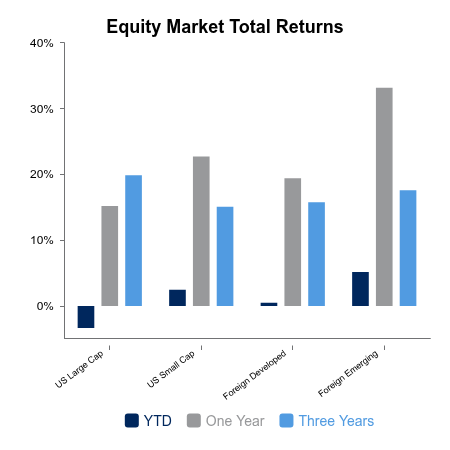
With ongoing conflict in the Middle East and limited economic data this week, investors are looking for a sense of direction for the economy and financial markets. Last week both equites and bonds declined with equities returning -1.6% and the broad bond market delivering a return of -0.2%.
Within the equity markets, the bright spot was small cap stocks with a positive return of 0.7% as measured by the Russell 2000 Index. Small caps also continue to be on the plus side for the year-to-date (YTD) period. As has been the case thus far in 2026, value stocks continued to outperform growth stocks. So far this year, the return for value stocks has exceeded the performance of growth stocks by 11 percentage points.
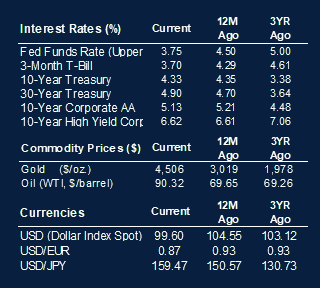
While international equities returns are still positive YTD, they have experienced steeper declines this month than their U.S. counterparts. For some foreign countries, the increase in energy costs over the past few weeks will affect their economies with a higher level of intensity compared to the U.S. Another factor impacting foreign markets over the past few weeks has been a strengthening of the U.S. dollar. After hitting a level of 96.22 on January 27, the U.S. Dollar Index has risen to a current value of 99.60.
Bonds were only marginally lower this week with the broad fixed income market returning -0.2%. This return, coincidentally, is the same for the YTD period.
Economic data releases were relatively light this week. Among the more significant releases were the final fourth quarter figures for Productivity and Unit Labor Costs. Both figures provided results that did not meet the consensus outlook. Productivity, with an increase of 1.8%, was below the prior quarter result of 2.8% while Unit Labor Costs rose 4.4% for the three-month period, significantly higher than the prior period level of 2.8%.
Despite the weaker than forecast result for Productivity, the trend for this measure continues to be positive and further implementation of AI is expected to reinforce the trend. The higher Unit Labor Costs are also not expected to continue at the pace seen in the fourth quarter. For reference, Unit Labor Costs increased 2.3% for all of 2025.
And finally, new home sales came in at 587,000 for the month of January, well below the forecast level of 713,000 and the slowest pace since 2022.
 |
 |
Sources: BTC Capital Management, FactSet Research Systems Inc., Federal Open Market Committee (Federal Reserve) LSEG I/B/E/S, FTSE Russell (an LSEG Group company), S&P Global, U.S. Bureau of Labor Statistics, U.S. Census Bureau
The information provided has been obtained from sources deemed reliable, but BTC Capital Management and its affiliates cannot guarantee accuracy. Past performance is not a guarantee of future returns. Performance over periods exceeding 12 months has been annualized.
This content is provided for informational purposes only and is not intended as an offer or solicitation with respect to the purchase or sale of any security. Statements in this report are based on the views of BTC Capital Management and on information available at the time this report was prepared. Rates are subject to change based on market and/or other conditions without notice. This commentary contains no investment recommendations and should not be interpreted as investment, tax, legal, and/or financial planning advice. All investments involve risk, including the possible loss of principal. Investments are not FDIC insured and may lose value.