

Equity Rally Back on Track
Key Takeaways
- Emerging market equities lead the way.
- Interest rates take a pause.
- Housing funk continues.
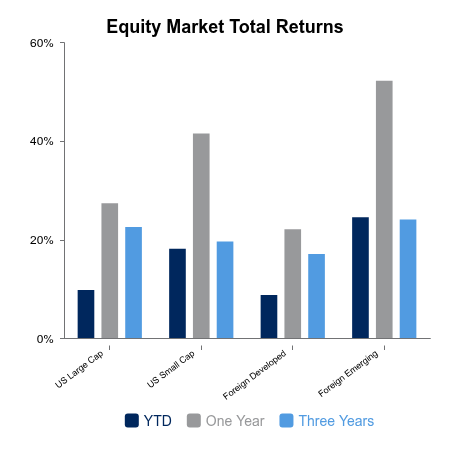
This week was relatively light in terms of economic data releases but heavy in regard to the ongoing momentum of equity markets. Domestic stocks, as measured by the Russell 3000 Index, advanced 2.6% for the week. This return, however, was dwarfed by the performance of emerging market equities with the MSCI Emerging Markets Index rising by 6.3%. The strength from emerging markets has been in place on a year-to-date basis, as well as they have returned 24.8% compared to the 10.3% return from the Russell 3000 Index. Within the domestic equity markets small cap stocks continue to provide leadership as they outperformed their large cap counterparts for the week and have also been dominant year-to-date.
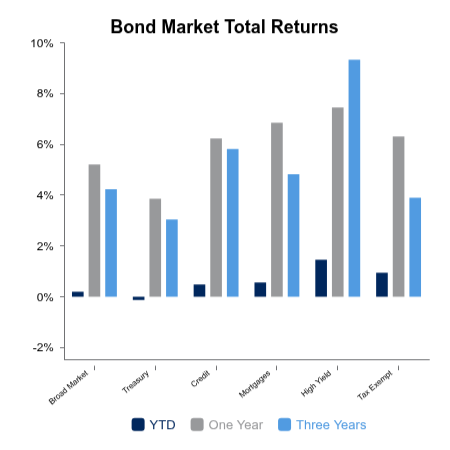
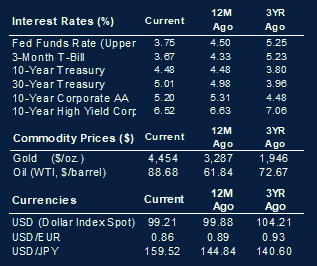
Fixed income also generated positive returns for the week as the broad bond market returned 0.6%. A slight decline in rates (the 10-year U.S. Treasury yield moved to 4.48% from 4.57%) helped propel bonds into positive territory not only for the week but also on a year-to-date basis as the broad market improved to a return of 0.1% for the period.
One of the highlights from this week’s economic data releases was a higher than forecast reading of the Conference Board’s Consumer Confidence Index. Consumer sentiment measures have been predominantly weak of late as survey respondents have expressed concerns over higher inflation and the labor market outlook. And while the Conference Board measure reported was lower than the prior month’s result, it exceeded the consensus forecast. Also, it was the first decline after three consecutive monthly increases.
Numerous pieces of housing related data were also released, and they continued to reflect the malaise that has characterized the industry since mortgage rates increased and home prices rose sharply higher. Housing starts, both on a monthly and annual basis, showed stronger than forecast results but both trailed the prior month’s reports. One positive note for prospective homebuyers was a decline in the S&P/Case Shiller Home Price Index which declined by 0.16% for the month. Home prices have been moderating as indicated by the year-over-year change for this measure which shows an increase of only 0.8%. In fact, numerous markets that saw the highest level of home price increases during the pandemic period have started to experience price decreases.
Upcoming economic data over the next week will be the second report of first quarter GDP growth. The result is anticipated to be unchanged from the initial estimate of 2.0%. There will also be an update on the Federal Reserve’s preferred measure of inflation, the Core PCE Deflator.
 |
 |
Sources: BTC Capital Management, FactSet Research Systems Inc., Federal Open Market Committee (Federal Reserve) LSEG I/B/E/S, FTSE Russell (an LSEG Group company), S&P Global, U.S. Bureau of Labor Statistics, U.S. Census Bureau.
The information provided has been obtained from sources deemed reliable, but BTC Capital Management and its affiliates cannot guarantee accuracy. Past performance is not a guarantee of future returns. Performance over periods exceeding 12 months has been annualized.
This content is provided for informational purposes only and is not intended as an offer or solicitation with respect to the purchase or sale of any security. Statements in this report are based on the views of BTC Capital Management and on information available at the time this report was prepared. Rates are subject to change based on market and/or other conditions without notice. This commentary contains no investment recommendations and should not be interpreted as investment, tax, legal, and/or financial planning advice. All investments involve risk, including the possible loss of principal. Investments are not FDIC insured and may lose value.