
Strong Economic Data Supports Likely December Rate Increase
Key Takeaways
- Fed signals another rate hike is likely in December.
- Inflation eased slightly but remains above target.
- Stocks declined while bonds delivered positive returns for the week.
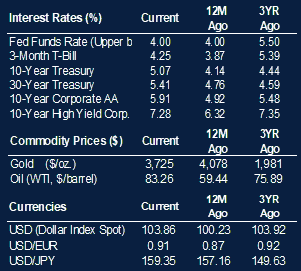
Economic releases for the week featured the Federal Open Market Committee’s minutes from their meeting held October 27–28. At that meeting the decision was to leave the Fed Funds rate unchanged, maintaining the target range of 3.75% – 4.00%. The committee will meet one more time this year on December 8–9. It is widely expected that the committee will raise their target range at that meeting by 0.25% to a level of 4.00% – 4.25%. Rationale for the increase is reflected in the committee’s meeting minutes which cited ongoing economic strength and a rate of inflation that continues to exceed its target of 2.0%.
Regarding inflation, the Producer Price Index for October was released with a month-over-month increase of 0.3%, lower than the level forecast. On a year-over-year basis the measure was again slightly lower than the forecasted level with a reading of 6.5%, the highest level since November 2022. Despite the monthly and yearly increases registering lower than forecast results, their levels support the prospect of the Fed Funds moving higher.
Retail sales results for the month of October were in line with expectations and have now increased for three consecutive months and have increased eight times out of the 10 months reported so far this year.
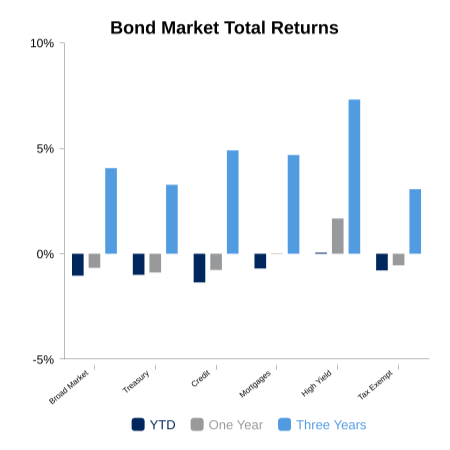
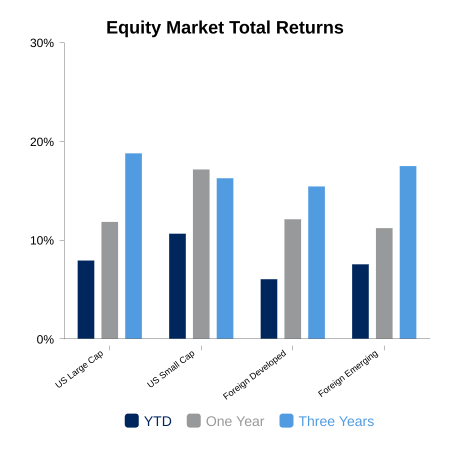
Financial markets moved in opposite directions this week as bonds delivered positive returns while equities declined. While fixed income did deliver a positive return of 0.3% for the week, its year-to-date return is still slightly negative coming in at -1.0%. Conversely, equity returns continue to be positive for the year-to-date period while seeing negative returns across the board for the week.
For the week, domestic equities experienced the smallest decline, seeing a return of -3.9% for the Russell 3000 Index. Emerging market equites had the lowest returns delivering a result of -5.8%.
While all major equity market indices have delivered positive returns year-to-date, we have seen a significant convergence in terms of performance across market segments. For example, at of the end of the third quarter emerging market equities were outperforming U.S. equities by over 12 percentage points for the nine-month period. Now that year-to-date differential is less than two percentage points. The primary contributor to this convergence is significant weakness in the performance of technology companies domiciled in Taiwan and South Korea.
Next week we will get an updated report of third quarter GDP. Currently it is expected to be unchanged from the original estimate of 3.4%.
 |
 |
Sources: BTC Capital Management, Bloomberg
The information provided has been obtained from sources deemed reliable, but BTC Capital Management and its affiliates cannot guarantee accuracy. Past performance is not a guarantee of future returns. Performance over periods exceeding 12 months has been annualized.
This content is provided for informational purposes only and is not intended as an offer or solicitation with respect to the purchase or sale of any security. Statements in this report are based on the views of BTC Capital Management and on information available at the time this report was prepared. Rates are subject to change based on market and/or other conditions without notice. This commentary contains no investment recommendations and should not be interpreted as investment, tax, legal, and/or financial planning advice. All investments involve risk, including the possible loss of principal. Investments are not FDIC insured and may lose value.