

Resilient Growth Confronts Sticky Inflation
Key Takeaways
- GDP growth beats consensus
- Post-Election relief and sub-$100 oil spark one-day stock and bond rally
The U.S. economy continued to demonstrate resilience this week, though the underlying picture remains uneven. Strong growth, stable labor demand, and expanding manufacturing activity are offset by persistent inflation and elevated long-end yields that continue to weigh on risk assets.
Third-quarter real GDP growth accelerated to 3.4% on an annualized basis, surpassing both the prior reading of 2.2% and the consensus forecast of 3.2%. Real final sales to private domestic consumers (an inflation-adjusted measure of underlying demand) surged 4.9% versus 4.6% prior, underscoring the durability of non-government spending.
The investment component of GDP was particularly striking. Nonresidential fixed investment grew 12.7% year-over-year (YOY), with equipment up 20% and computers and peripherals surging 70.5% at a $504.1 billion annualized rate in third quarter 2026, figures that reflect the growing footprint of AI-related capital expenditure in the broader economy. Household spending remained solid at +3.8%. The one persistent weak spot was residential investment, which contracted 3.3%, with mortgage rates elevated near 7.3%.
Inflation remained sticky. The PCE price index (the Federal Reserve’s preferred gauge) held at 3.6% YOY, with core PCE at 3.1%. The Employment Cost Index rose 0.8% in third quarter, trailing inflation for a second consecutive quarter and signaling continued real wage compression for workers.
The ISM Manufacturing Index came in at 55.5, beating the 54.5 consensus estimate on stronger-than-expected factory orders, its second-highest reading in two years and a clear signal for broadening industrial activity. The ISM Services Index registered 54.5, indicating continued expansion in the services sector, though the underlying details pointed to a moderation in business activity growth.
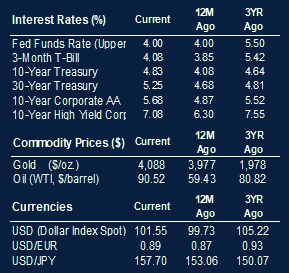
Job Openings and Labor Turnover Survey (JOLTS) job openings for September exceeded expectations at 7.52 million, up from 7.08 million in the prior month, equating to approximately 1.06 job openings per unemployed worker. The data reinforces a picture of stable labor demand and when combined with the broader employment backdrop, provides the Federal Reserve with sufficient cover to raise the overnight borrowing rate to 4.25% at its December meeting.
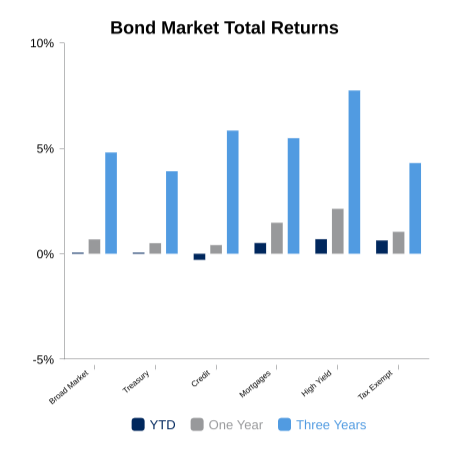
Financial markets were shaped primarily by midterm election results, which prompted investors to reprice fiscal risk lower and factor in the prospect of reduced Middle East tensions. A ~8.7% single-day decline in Brent crude, falling below $100 per barrel, provided additional support for gains for fixed income.
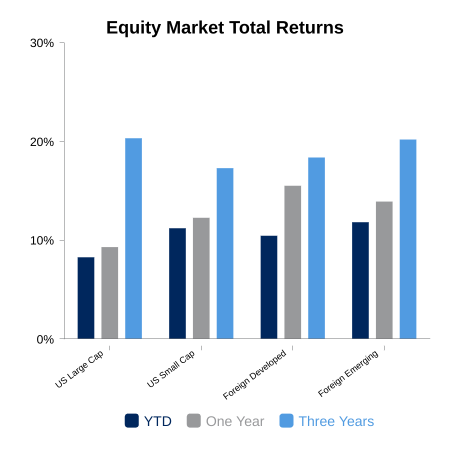
Bonds posted gains (+0.56%) as yields retreated on optimism of an improved fiscal outlook. U.S. equities staged a strong Wednesday rally but fell just short of recovering losses from earlier in the week (-0.34%). International equities mirrored the pattern of their U.S. counterparts—an initial mid-week dip followed by a partial recovery—but also closed the week modestly lower (-.45%).
 |
 |
Sources: BTC Capital Management, LSEG (London Stock Exchange Group), U.S. Federal Reserve, MSCI Inc., The Conference Board, S&P Global, Bloomberg LP
The information provided has been obtained from sources deemed reliable, but BTC Capital Management and its affiliates cannot guarantee accuracy. Past performance is not a guarantee of future returns. Performance over periods exceeding 12 months has been annualized.
This content is provided for informational purposes only and is not intended as an offer or solicitation with respect to the purchase or sale of any security. Statements in this report are based on the views of BTC Capital Management and on information available at the time this report was prepared. Rates are subject to change based on market and/or other conditions without notice. This commentary contains no investment recommendations and should not be interpreted as investment, tax, legal, and/or financial planning advice. All investments involve risk, including the possible loss of principal. Investments are not FDIC insured and may lose value.